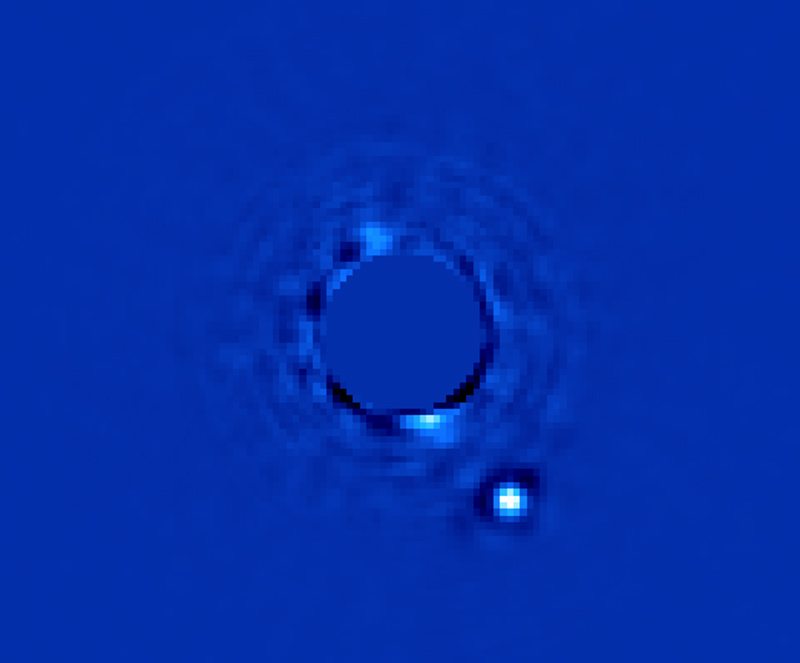
Image of a planet outside our solar system(an exoplanet)

zimok

Click, Whirr.
Oct 27, 2008
2,391
99
0
Canada... eh!
BetaPictorisb.jpg


Mind boggling. You're looking at a representation of a planet(and it's star) that's 63 light years away. HOW FUCKING COOL IS THAT?

Here's a quote from one of the scientists,

“Some day, there will be an instrument that will look a lot like GPI, on a telescope in space. And the images and spectra that will come out of that instrument will show a little blue dot that is another Earth.”
– Bruce Macintosh, GPI team leader

This makes me wonder if we've been looked at from some distant alien colony, and for a time, entered the consciousness of another sentient being light years away from us.

sources


The way more interesting question is, whether that's our own planet we are looking at due to the universe being of some exotic topology.
 
It looks like a bullet hole in some glass. Pretty shitty. When we get images like this I will be impressed.
JR4CsF9.jpg
 
Is that a photo of sorts? There was an actually image of a planet taken but it was just like a dot. I would love so much to see exo planets. When I was in school to me the most awesome thing to learn about were the moons in our solar system. Many of them are bigger than some of the planets which to me was basically like learning about new planets. In the first Mass Effect game you can land on at least one planet per system and while the textures were great I really loved the alien terrain and especially the sky and moons on each different planet you could land on, one was in the middle of a meteor shower and you could see shooting stars. Maybe someday 2000 years from now if the human race doesn't annihilate itself and learn some trick to move faster than light people will be standing on alien planets for real taking 6D footage at 25K and still uploading it to some google service.
 
The way more interesting question is, whether that's our own planet we are looking at due to the universe being of some exotic topology.

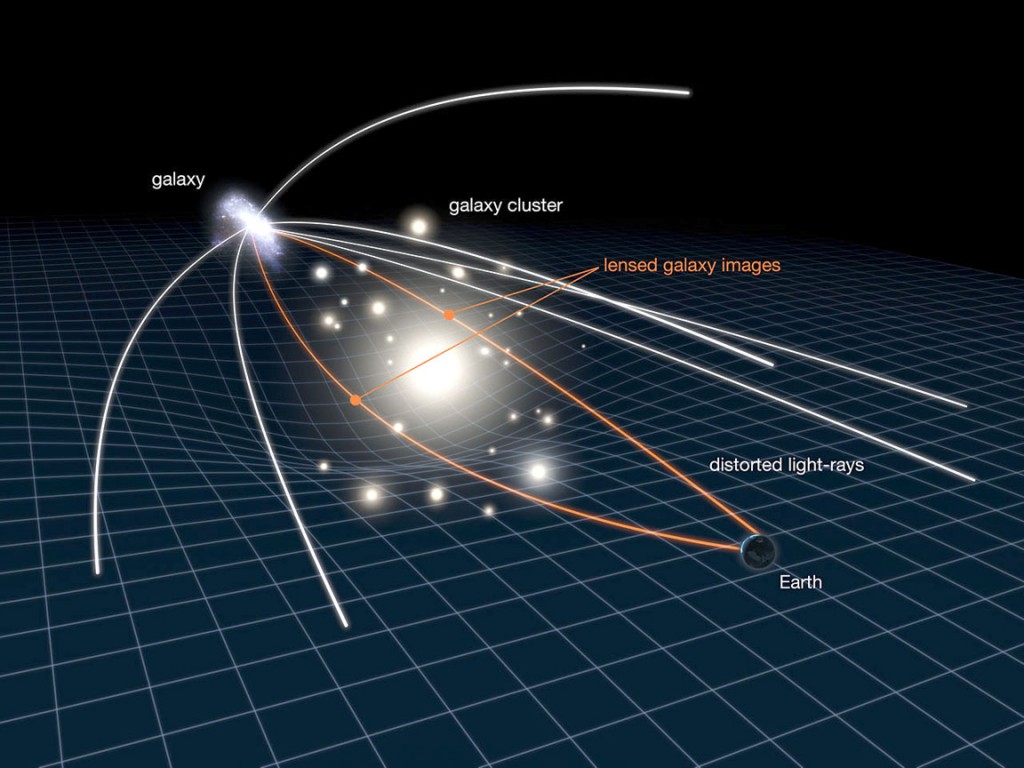
For this specific example they know that it's a planet 60% larger than Jupiter, so it wouldn't be our own. Maybe you're thinking of gravitational lensing? This occurs when a massive object is between what's being observed and the observer, bending the light and creating the illusion that you're looking at two(or more) bodies, when there's only one in reality(the reality we're observing in our time frame, which is the past reality of what's being observed).

Gravitational-lensing-galaxyApril12_2010-1024x768.jpg


For exactly what you're describing to be true, would be if several black holes lined up perfectly to loop back Earth's light back unto itself - I doubt the data from that light could ever be constructed in a meaningful image such as this one though... but who knows - and this would also mean that we'd be looking at the Earth in its distant past... maybe when it was a cloud of debris around our star.
 
No, im talking about topology, not gravitational lenses.

What you think space "looks" like is just one of a lot of possible ways for space to be.

Topology is a level above what youre thinking of.
 
No, im talking about topology, not gravitational lenses.

What you think space "looks" like is just one of a lot of possible ways for space to be.

Topology is a level above what youre thinking of.

Would still be like 1:1000000000 chance of that being the case. Even if the topology assumption would be true the scientists still had to pick one star out of X(n) to observe.
 
For this specific example they know that it's a planet 60% larger than Jupiter, so it wouldn't be our own. Maybe you're thinking of gravitational lensing? This occurs when a massive object is between what's being observed and the observer, bending the light and creating the illusion that you're looking at two(or more) bodies, when there's only one in reality(the reality we're observing in our time frame, which is the past reality of what's being observed).

Gravitational-lensing-galaxyApril12_2010-1024x768.jpg


For exactly what you're describing to be true, would be if several black holes lined up perfectly to loop back Earth's light back unto itself - I doubt the data from that light could ever be constructed in a meaningful image such as this one though... but who knows - and this would also mean that we'd be looking at the Earth in its distant past... maybe when it was a cloud of debris around our star.


Did you see that video on youtube about gravitational lensing? Amazing. The scale of what's happening with light and gravity sort of bent my mind slightly.
 
Is that a photo of sorts? There was an actually image of a planet taken but it was just like a dot. I would love so much to see exo planets.QUOTE]

Here's how the picture was formed,

To to do it, the Gemini Planet Imager (GPI), an instrument at the 8-meter Gemini South telescope in Chile, uses a number of advanced tools, including sophisticated adaptive optics to remove the blurring effects of the Earth's atmosphere, a coronagraph that removes starlight so planets can be seen, an infrared sensor, and a spectrograph.

The near-infrared image above shows the planet glowing in infrared light from the heat released in its formation some 10 million years ago. The bright star, Beta Pictoris, is hidden behind a mask in the center of the image. The visualization still contains a few scattered starlight artifacts, called speckles, but they're vastly fewer than in previous images.
source

It's not a picture in the traditional sense. It's more of an amalgamation of different systems that produces a model of what's being observed.

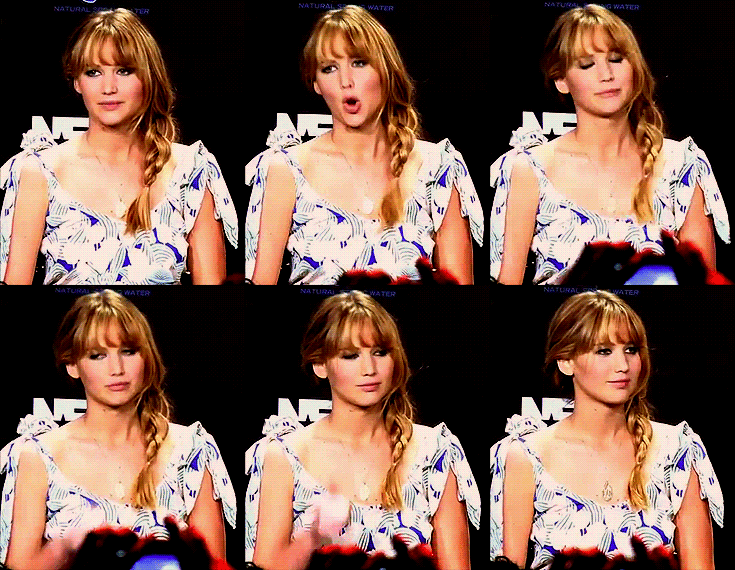
An analogy would be having several pictures of Jennifer Lawrence. Each picture containing some detail as to her stature, color, breast size, height... but no picture holds the whole story, so they're layer together using mathematics to produce a model that's as accurate as possible.
 
No, im talking about topology, not gravitational lenses.

What you think space "looks" like is just one of a lot of possible ways for space to be.

Topology is a level above what youre thinking of.

The 'level above'/topology wouldn't produce what you described in your first post.

Only in our local universe could the radiation from Earth be looped back unto us.

This is because the 'edge', the medium of space which is carrying that information, is expanding faster than the light it's carrying.

(As far as I know... and if you have something to read to elaborate.. I'd like to read it)
 
You implicitly assume that light would have to be confined to the dimensions you know as space. Even experimental evidence exists that suggests the opposite might hold.

And the way you imagine space expanding is a bit naive.


Beyond that, Im not trying to convince anyone that this might be our own planet. Its just a less boring topic to actually think about.
 
this is a cool channel
[ame=http://www.youtube.com/watch?v=xBt_CfiWXXI]Space Fan News #99: Second Most Important Image; Herschel's Black Holes; ALMA Redefines History - YouTube[/ame]
[ame=http://www.youtube.com/watch?v=oAVjF_7ensg]The Hubble Ultra Deep Field in 3D - YouTube[/ame]
 
You implicitly assume that light would have to be confined to the dimensions you know as space. Even experimental evidence exists that suggests the opposite might hold.


Of course I assume that, because what we're observing in this image is entirely confined to the dimensions of three dimensional space.

And the way you imagine space expanding is a bit naive.

giphy.gif
 
You implicitly assume that light would have to be confined to the dimensions you know as space. Even experimental evidence exists that suggests the opposite might hold.

And the way you imagine space expanding is a bit naive.


Beyond that, Im not trying to convince anyone that this might be our own planet. Its just a less boring topic to actually think about.


It's ok wayn3, we get it. We are all ants and retards. You are beyond awesome. You are like a star, and we are crusty little meteorites that disintegrate with your awesomeness.

And you are totally right. It is so much more awesome to imagine highly unlikely scenarios that would be a hit on TV, rather than the boring analysis of the most likely reality and the breakthroughs that come thereof.

Thank you for your contribution to this thread. Your condescension and awesomeness shine through like a super nova.
 
I'm hypothesizing that it's Earth in a parallel universe, but my data isn't exactly ready to be published yet, so I'll get back to you after peer review.